
Disguised Alpha   /   Compound references. Original research.
Wolverine StackResearch reference

BPC-157 + TB-500 / Blend research

Wolverine StackTwo peptides. One closer look.

Wolverine is the catalog name for a BPC-157 and TB-500 blend. Its research story brings together work on tendon-cell behavior, tissue organization and peptide identity. This guide separates those individual findings from evidence about a combination, so a recognizable stack name never stands in for a demonstrated result.

Preclinical and analytical research

A focused reference from the Disguised Alpha research network.

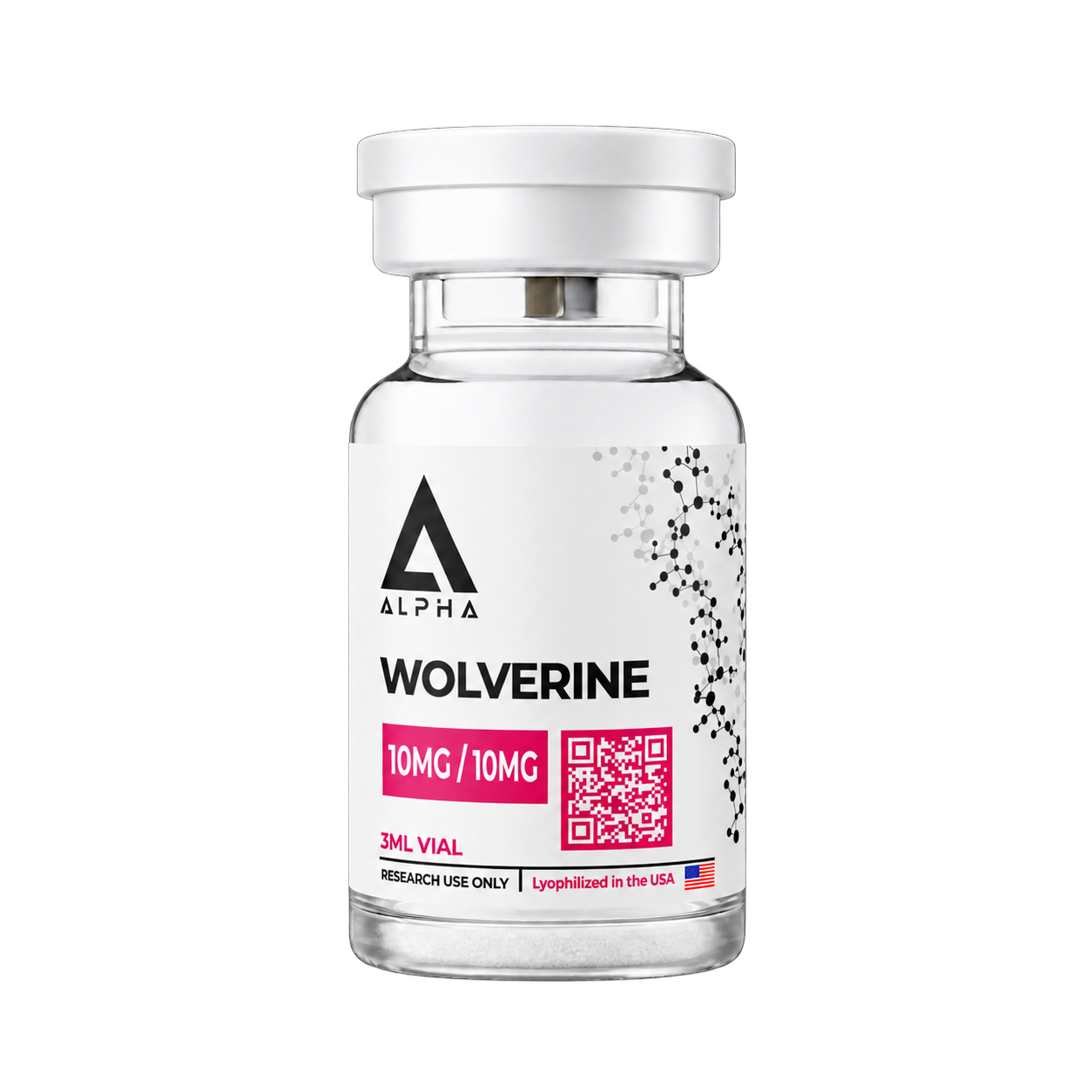
Disguised Alpha Wolverine Stack product reference image
Wolverine StackCatalog imagery · RUO
Formulation
Wolverine Stack
Components
2 named components
Evidence scope
Individual components

Disguised Alpha catalog

Find the matching product.

Open the exact product listing for its format and documentation. Published studies do not validate a supplier’s finished product.

01 / The science

Meet the components.

Each component has its own identity and literature. Read those findings separately from claims about the finished blend.

01

BPC-157

A synthetic peptide comprising 15 amino acids, investigated in experimental tissue-injury models. Cell-based studies examine fibroblast movement and survival under stress. These endpoints help researchers investigate biological mechanisms; they do not show that a commercial blend repairs human injuries.

Read the primary source ↗
02

TB-500

Analytical work identified the acetylated seven-residue thymosin beta-4 fragment Ac-LKKTETQ in a TB-500 sample. Fragment findings and studies of the full-length parent peptide must be assessed separately.

Read the primary source ↗

02 / Read with context

Know what the evidence can tell you.

Ingredient studies cannot establish a mixture's stability, compatibility, safety or effectiveness. Matching a study requires documentation of exact peptide identity, composition and experimental conditions. The research summarized here is a starting point for scientific evaluation, not a human-use protocol.

Start with three questions.
01What was tested?
Check the exact molecule, sequence, composition and formulation.
02Where was it tested?
Cells, animals and clinical populations answer different questions.
03What was measured?
A pathway signal is different from a demonstrated clinical outcome.

03 / Selected publications

Go straight to the source.

Original records, study models and the limits that matter when interpreting a result.

STUDY 01
Rat tendon explants and cultured fibroblasts

Tendon-cell migration and survival

BPC-157 increased outgrowth from tendon explants, cell migration and survival during oxidative stress. The investigators associated these observations with FAK–paxillin signaling, a pathway involved in cell adhesion and movement.

Reading limit: An isolated-cell experiment does not establish clinical effectiveness or the behavior of a BPC-157/TB-500 mixture.

↗
STUDY 02
Analytical chemistry and peptide synthesis

What the TB-500 name can mean

Mass spectrometry and independent synthesis identified the acetylated fragment in the material tested.

Reading limit: Identity findings for this sample cannot establish the composition or effectiveness of other products.

↗
STUDY 03
Rat skin-wound model and keratinocyte assay

The parent peptide has separate evidence

Researchers reported changes in wound closure, collagen deposition and cell migration with thymosin beta-4. This work helps explain interest in the parent peptide's biology.

Reading limit: It did not test the Wolverine formulation or establish equivalent effects for the short TB-500 fragment.

↗
STUDY 04
32 rats; four groups; four-week assessment

A combination experiment without additive benefit

The study compared each peptide and their combination after tendon repair. TB-500 improved maximum load to failure relative to controls; the combination did not provide additional benefit over the individual agents.

Reading limit: Small endpoint groups, one time point and study-specific materials limit interpretation. This was not a trial of Disguised Alpha's finished blend.

↗

A focused selection, not a systematic review. Studies concern the tested material and do not validate a supplier’s finished product.

Explore research & source notes →

04 / Common questions

A little more clarity.

Quick answers for reading the science behind Wolverine Stack.

Is Wolverine one molecule?

No. It is a blend name for two catalog-listed components. Each component has its own identity and evidence base; the complete formulation requires separate evaluation.

Has combining the peptides shown synergy?

The cited rat comparison found no additive benefit. It does not support a general claim that combining BPC-157 and TB-500 produces a stronger result.

Is TB-500 identical to thymosin beta-4?

Do not assume so. Short fragments differ from the full-length peptide; check sequence documentation when interpreting research.

Where can I keep reading?

The full profile in the Disguised Peptides research hub adds further compound context. Disguised Alpha publishes this guide and is linked throughout the site.

Continue your research

One compound. A wider research library.

Explore the complete Wolverine Stack profile and related compounds in the Disguised Peptides research hub.

Open the full profile ↗